How Quality Printing Enhances Your Brand Image

In today’s competitive world, having a great product is just not enough. Particularly if we talk about business, the strategy is the backbone of the success of any brand. But some brands often forget about the essential part of the strategy i.e. printing. That’s right, professional printing is essential to enhance your company’s brand image. Professional printing done right can boost a product portfolio and instil confidence in customers. So let’s see how printing impacts brand image.
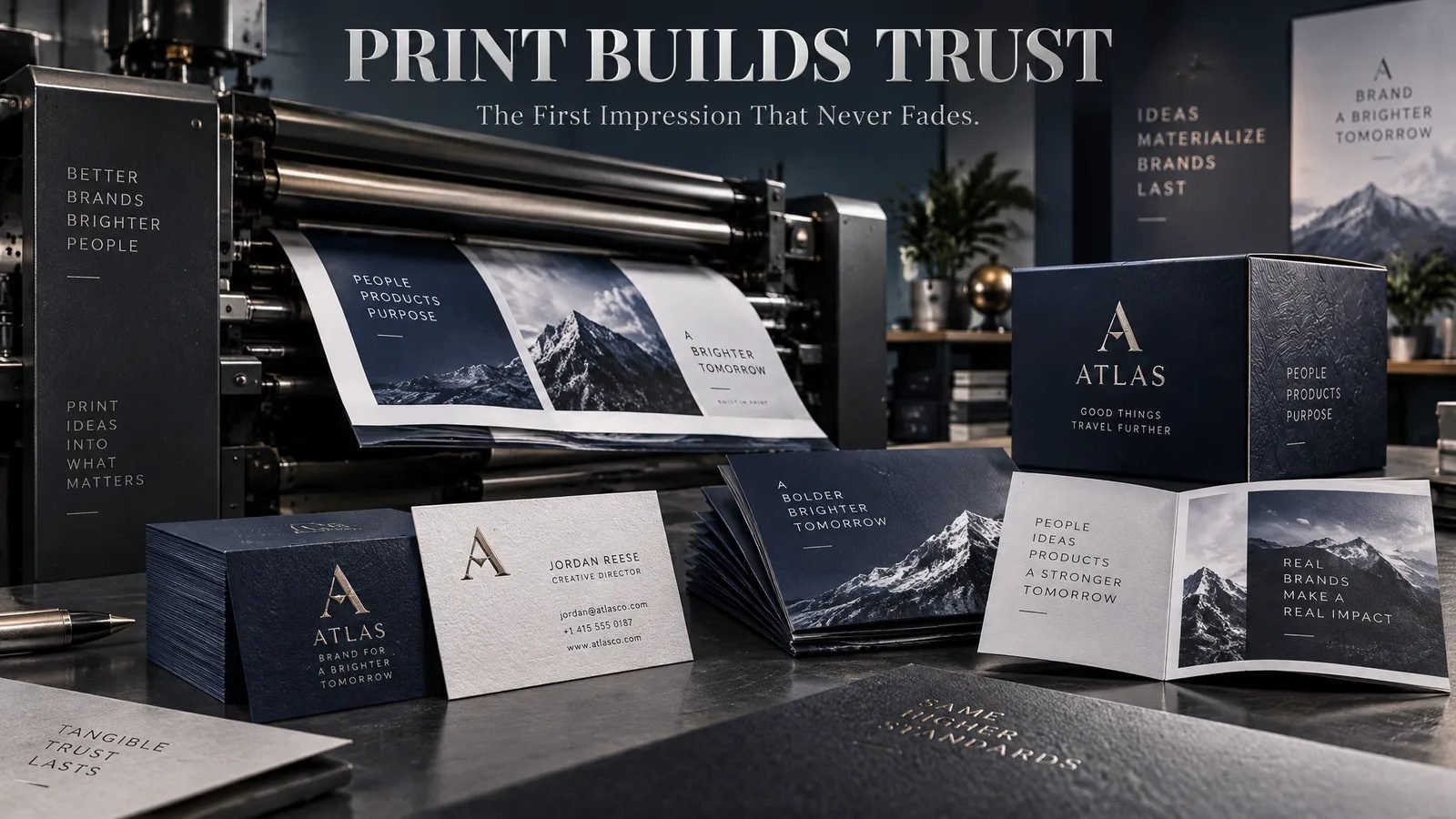
Elevate Quality Perception with Professional Printing Whether it’s your business cards, marketing brochures, or product packaging, professional printing sets you apart instantly. Today, modern expert printers can offer high-quality printing of materials that are durable and eye-catching as well. In addition, they also offer finishing options like foil stamping and lamination that can take your print material to the next level.
Your marketing material or product packaging reflects your brand image. Thus it is essentially important that you choose quality professional printing services to create those impactful materials. This shapes your consumer’s perception when they see your print material they will perceive your quality to be that quality only.
Enhance Customer Trust Working with professionals helps you to avoid the risk of printing errors. Errors in your print material can annoy your potential customers. They create a confounding experience
When printing is managed professionally, you will enhance your brand image. Your colors will be perfectly matched with the right material and finish. The paper of your business cards, brochures, packaging and signages will reflect a professional image if the printing is done right. This builds customer trust, supports brand recognition, and creates the tangible first impression that will heavily influence how clients and partners judge a business’s credibility.
Most organizations allocate big budgets for digital branding, designing a sleek website, being actively present on social media along with polished ads, and treat printing as a mere afterthought handled by whichever local place is cheapest or fastest. What’s more, that printed business card, brochure or product box is often the first tangible object a customer will ever physically own, and the quality of this speaks louder than a post online. This guide explains how professional printing can strengthen your brand image, what happens when it isn’t taken seriously, and how to choose a printer that gets it right.
Essential Points.
- Professional quality printing involves the use of calibrated presses, carefully chosen materials, and finishing techniques that exceed the production capabilities of a home or office printer.
- A brand is more than just its website, and it’s important to understand that brand image is the result of every physical touchpoint the customer comes across (business cards, brochures, packaging, signage. etc.).
- Using the same color, typography and quality of paper in all printed materials will create brand recognition and projects reliability.
- If the printing is of poor-quality or doesn’t have consistency, then it can actively damage trust. Roughly, 39% of people will not do business with anyone who has a cheap-looking business card.
- According to a study, a much higher percentage of people trust print as compared to digital ads. So, print is still one of the most trusted channels.
- By adding QR codes and NFC chips (phygital marketing) to a print, it can have a wider reach and measurable than it can otherwise.
- The choice of a professional printing service provider offers the ability to select colour-matched, quality materials and design guidance at a low cost to strengthen brand credibility instantly.
What is professional printing and how is it distinct from regular printing?

Professional printing makes use of calibrated equipment as well as premium materials and finishes to produce consistent, quality products. It varies from printed office or home assets in every possible technical aspect from ink system to the kind of paper stock that is used.
Imagine Two Versions of a Business Card The print from a home inkjet printer on normal 24-lb paper comes off looking a little washed out with colors and smudges if you touch it too soon. Another variant comes from a commercial press that employs the CMYK process with Pantone colormatching. 350gsm weight stock paper; matte or soft-touch finish. When we tested both formats side by side, there was an immediate difference. The pressed card just feels heavier, the colors are sharper, and the finish says that real money and thought has gone into it. The difference in physical weight is aesthetic but is the first data point a client uses to determine whether your business is serious or improvised.
Printers offer finishing options embossing, foil stamping, spot UV coating and die-cutting which home setups simply cannot produce. When an image is designed for flat printing before it is printed, the result becomes conscious branding rather than incidental branding.
Why Brand Image is Important for SME’s in Pakistan?

A small or medium enterprise should be concerned with their brand image because it can make or break a sale. The customer may trust a business enough to make a purchase or sign a contract, often without saying a word. The SME sector in Pakistan is growing organically but is not making full use of the online tools available at his disposal. For example, companies in Lahore, Karachi, Islamabad and Faisalabad are very much dependent on references and physical meetings. As a result, the physical presentation of the brand holds huge importance in obtaining B2B business.
Across the pages of different industry print and branding articles, one thing is mentioned time and again: print gives a company a face. To summarize the cycle we just went through, print is your brand’s first voice, at three touchpoints before you do. The handoff is when you hand the person you’re meeting a business card or an invoice. The second is counter, a customer holding your packing or reading through your brochure in a shop or office lobby. The third is the mailbox, a piece of direct mail or a corporate gift that lands on the desk of a client. In each of these three moments, print is speaking for you and that is precisely why its quality cannot be an afterthought.
In a Digital-First Era, Is Print Marketing Still Relevant?
In 2026, print marketing remains highly relevant as it consistently earns higher trust and top-of-mind recall than many digital formats. More than half the consumers trust print marketing more than other advertising forms. Also, more than 60% of the readers trust print, compared to 42% of online.
Similar data has been proven by recall data. Print media leads the way among all ad media with 90% brand recall. Spending on advertising reflects how relevant print media continues to be. Global print advertising spend is forecast to hit $32 billion by 2025. In particular newspaper ad spend is $21.85 billion. According to the figures, newspapers alone make up $21.85 billion out of the overall $32 billion. That leaves just under $10 billion for brochures, direct mail, packaging and business cards. This is a market category competitor seldom breaks down. Nonetheless, it proves print is still a long way off from dying channel.
How does professional printing elevate the image of your brand? 7 Major Ways

Using professional printing in your marketing materials creates brand consistency, perceived quality, trust and tangibility. Differentiate your business from the competition, and offer customization ideas. Here are seven practical illustrations on how these play out.
1. Develops uniformity in branding at every touchpoint.
Maintaining a consistent brand look across your printed material will help your customers link a particular colour, font, and logo on a business card with your service. When you hire a pro printer, they use Pantone matching to ensure your blue or red is the same colour on your brochure, your banner, and your product box rather than shifting slightly with each print run.
2. Signals worth depending on materials.
The weight, texture, and finish of the paper speak quality before a single word. When a brochure is printed on thin, flimsy stock, it reads as low-budget. But, the same content printed on heavier, coated stock reads as premium, regardless of the actual price difference between the two jobs.
3. Enhances trust and validity.
What is the impact of quality on trust? When a business has sharper colours, cleaner cuts and a premium finishing, it shows stability and attention to detail. Customers directly translate that into credibility. This connects to a more general trust pattern in print. Readers already trust printed material more than they do most digital ad formats.
4. Designing Something You Can Hold on To
How do business cards shape our first impressions? According to research conducted by Wave Connect in 2026, 72% of consumers said that their first impression of a brand stemmed from a business card. This means that small card represents one of the highest-leverage brand assets a company owns. A sturdy card is kept while a flimsy one is tossed away almost immediately.
5. Distinguishes You from Other Competitors.
Most local competitors use a common finish and a common stock. A business that spends money on a special texture, a spot UV logo, or an unusual die-cut shape on its packaging or brochure stands out just by feeling different in the hand.
6. Provides Customization That Represents Brand Personality.
Using distinctive finishes, shapes and sizes allow brands to print pieces which seem purposely built as opposed to mass produced. This customisation gives the idea that a brand is particular about everything in its circle and not just what it prints.
7. It Helps Remind Long After Using It.
Direct mail requires 21% less cognitive effort than digital media, according to a Canada Post and True Impact Marketing neuroscience study. As a result, it leads to 70% higher brand recall. In other words, a well-printed piece that’s sitting on a desk continues to work for your brand long after a digital ad has been scrolled past.
What Will the Results Be When a Business Uses Cheap Printing?
If the print quality is low or temporary, it can hurt customer trust. According to the 2026 business card statistics report by Wave Connect, almost 39% of individuals would avoid transacting business with someone if they had a “cheap-looking” business card.
When we compare that against the earlier recall numbers, then the risk compounds quickly. The first impression is a make or break, especially for the 72% of consumers that make a purchasing decision based on the initial impression a business card gives off. Furthermore, 39% of those consumers will reject that impression outright over a cheap-looking business card. Well over a third of potential clients are screening a business out before a conversation even starts, based off just a piece of paper! This is not simply a design complaint; it’s a quantifiable loss of leads that is directly tied to a print decision most business owners make as an afterthought.
Digital Printing and Offset Printing- Which Build a Better Brand Image?

Though both digital and offset printing can effectively build brand image, their suitability varies based on factors like volume, cost and turnaround time. Digital printing directly applies toner or liquid ink from a digital file, while offset printing uses plates to transfer ink to rubber rollers before it reaches paper, resulting in sharper color accuracy at higher volumes.
| Factor | Digital Printing | Offset Printing |
|---|---|---|
| Best for | Short runs, variable data, quick turnarounds | Large runs (500+ units), maximum color precision |
| Cost per unit | Higher at large volumes | Lower at large volumes |
| Turnaround time | Fast, often same-day to 48 hours | Slower, plate setup adds lead time |
| Color accuracy | Good, improving with newer presses | Excellent, especially with Pantone matching |
| Typical use case | Business cards on demand, small brochure batches | Bulk brochures, packaging, corporate stationery |
An Lahore startup could print 100 business cards for a launch event; we recommended digital as faster and cheaper. For a manufacturer in Karachi who requires 5,000 boxes of branded products, offset printing will win on print quality and the cost per box. No format is better than the other in terms of brand image. It depends on the volume you are producing and how tight of a color match specificity you need for your larger batch.
How Businesses Unify Print And Digital (Phygital) Marketing to Improve Brand Image?
Phygital marketing is a strategy that uses printed pieces with digital touchpoints, such as QR codes and NFC chips, so a printed piece links directly to an online experience. This combines confidence in print with the reach and measurability of digital. In 2026, this is expected to feature in more print campaigns as a standard than a novelty.
Imagine a Lahore-based boutique printing a brochure to showcase its collection. Rather than documenting every item on paper, the brochure has just one QR code that opens directly to an Instagram catalog with live pricing and stock. The tactile, trustworthy brochure is kept by the customer. However, they can access an updated digital storefront at a moment’s notice. The boutique can also see how many scans that print run generated. NFC chips placed in packaging or smart business cards work in a similar way, just tap your phone on it and it’ll open a portfolio, payment link or contact card.
How To Select A Reliable Professional Printing Company?

When you’re looking for a reliable professional printing company, you should actually check out the kind of services on offer, their turnaround consistency and the quality of their portfolio before placing a large order. Vistaprint and other known printing agencies can help you to get your digital printing facility. IRA Imaging, PrintFast, Pro Vendors, Aprints.pk, Click to Print and Adzown agency of Lahore, can be very useful.
A Checklist for Vetting a Local Vendor.
- Portfolio consistency: Value consistency of color and finish as much as the design itself. Ask to see three past jobs. You should see the designer’s signature color and finish treated equally throughout.
- The turnaround time is not verbal and is written especially for offset run.
- Before authorizing an entire run, obtain physical samples of the cardstock or weight of the paper.
- Make sure that they can match the Pantone colours and not just the CMYK values.
- When choosing vendors, lean towards the ones who will take the time to flag your errors in your files. Or who will suggest that you do a finish upgrade. Rather than just printing whatever you uploaded, errors included.
- Option for short runs offset bulk pricing Maximum order flexibility prices may vary, ask for a quote to see if you can save on a project!
The vendors that often pass this checklist in practice are those that have already developed solutions with recognizable local brands since quality of portfolio tends to correlate directly with process discipline.
Assessing What You Currently Have in Print.
The next step is simply auditing whatever your business currently prints. Take out your most recent business card, brochure, and any packaging or signage you use and lay them out side by side.
Assess three things: do the colors match perfectly on all pieces, do the paper or material correspond with the price point you want to portray, and does a first-time customer call any of them cheap? If even one of the above questions got a “yes” for you, that piece is actively undermining the brand image you’re trying to create on your site, in your advertising and in your service.
Conclusion.
Professional printing should not be viewed as a cost to control; rather, it is a physical manifestation of your brand’s credibility. This credibility is formed through consistent use of colour, quality materials, and smart finishing of every business card, brochure and package you print. Print and digital marketing should work together for best success. In fact, establish marketing coordination so print and digital work together. Start small Audit your printed piece of collateral and then get it printed professionally. Choose the weakest piece in your range of printed documents, get a quote for the upgrade and have it ready before the next client meeting.