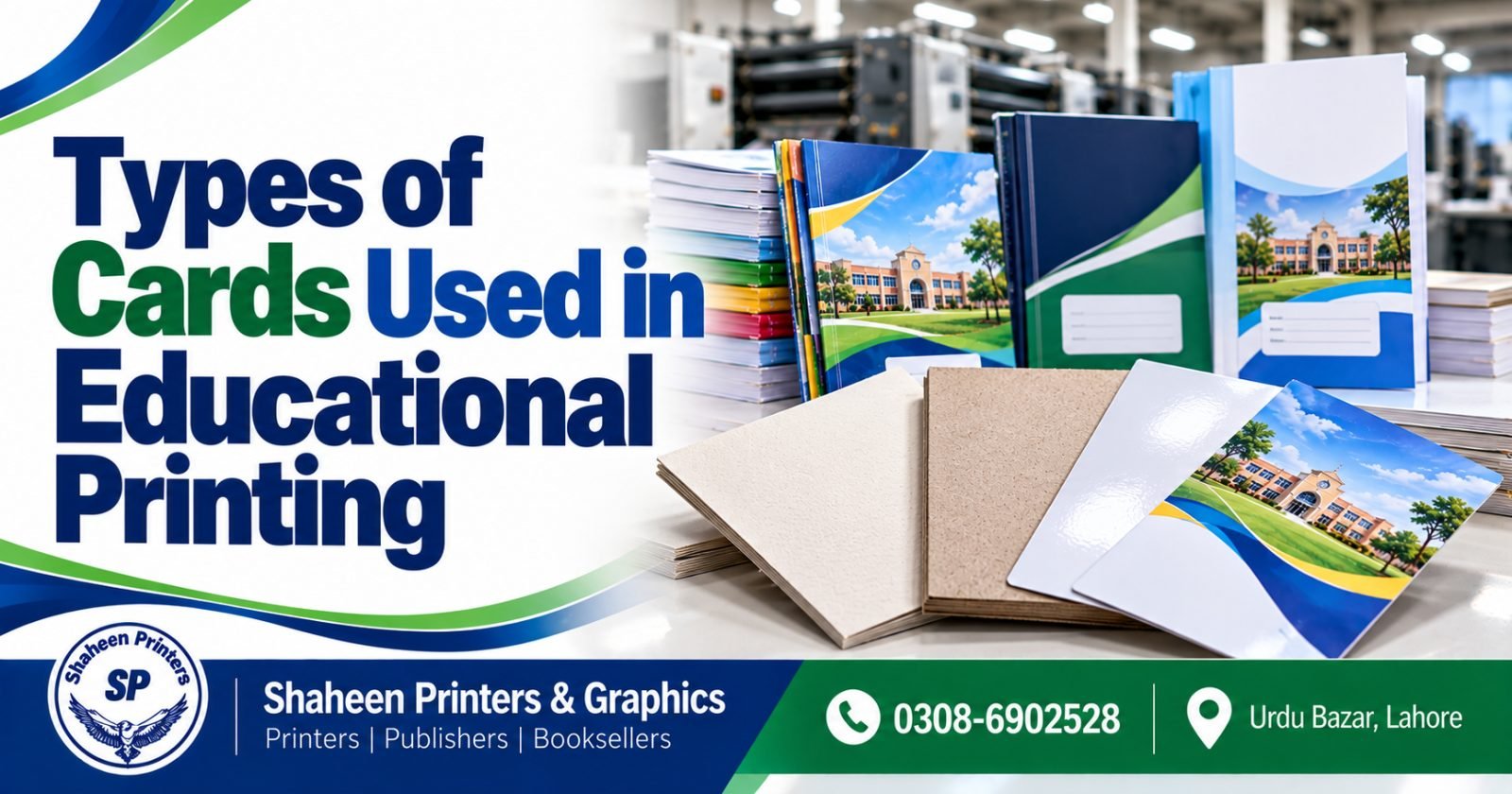
Types of Cards Used in Educational Printing: Baleech Card vs Bux Board vs Art Card
Choosing the right printing card is one of the most important decisions when ordering customised school notebooks, student diaries, file covers, certificates and other educational stationery.
A beautifully designed notebook cover may lose its appeal if the card is too thin, bends easily or does not reproduce the school's colours properly. Similarly, choosing unnecessarily expensive card material can increase printing costs without providing a meaningful benefit.
In Pakistan's educational printing industry, three card materials commonly discussed for different cover and stationery applications are Baleech Card, Bux Board and Art Card.
Each material has different characteristics, printing possibilities, finishing requirements and cost considerations.
Shaheen Printers & Graphics, an educational printing specialist based in Urdu Bazar, Lahore, helps schools, colleges, academies and publishers explore suitable materials for customised printing projects.
In this guide, we explain the differences between Baleech Card, Bux Board and Art Card, their practical uses, GSM considerations, printing quality and how to choose the right option for your institution.
Want to compare real printing materials?
Explore our Paper & Printing Samples and review our Printing Portfolio.
What Are Printing Cards?
Printing cards are relatively heavy paper-based materials used when a printed product requires more stiffness, strength or presentation quality than ordinary writing paper.
Unlike the lighter sheets used inside notebooks and diaries, card materials are often selected for covers, folders, certificates and packaging-related applications.
In educational printing, cards may be used for:
School notebook covers
Student diary covers
Register covers
Student portfolio files
Admission file covers
Certificates and awards
Report card covers
School presentation folders
Book covers
Educational packaging
The appropriate card depends on the product's purpose, expected handling, printing design, finishing process and budget.
Quick Answer: Which Card Is Best for Educational Printing?
Art Card is often a strong choice for colourful, high-quality printed covers; Baleech Card can be considered for economical school stationery applications; and Bux Board may be suitable for products where board stiffness and construction are important.
However, there is no single best card for every educational printing product.
Card quality, thickness, coating and stiffness can vary between suppliers and grades. Schools should compare actual samples before making a bulk printing decision.
Baleech Card vs Bux Board vs Art Card: Quick Comparison
| Feature | Baleech Card | Bux Board | Art Card |
|---|---|---|---|
| Material category | Trade-name card grade | Board-type material | Coated printing card |
| Surface finish | Depends on supplied grade | Depends on supplied grade | Usually smooth and coated |
| Colour reproduction | Grade-dependent | Grade-dependent | Often suitable for detailed colour printing |
| Stiffness | Depends on thickness and composition | Often considered for board stiffness | Depends on GSM and grade |
| Lamination | Confirm compatibility | Confirm compatibility | Commonly used with suitable lamination |
| Main buying priority | Economy and suitability | Construction and rigidity | Print appearance and branding |
| Educational applications | Selected covers and stationery | Covers and backing applications | Diaries, notebooks, folders and branded covers |
Important: Baleech Card and Bux Board are trade terms that may describe different stocks in different printing markets. Their exact fibre composition, coating and stiffness should be confirmed with the supplier. The comparison above describes general buying considerations rather than universal material specifications.
1. What Is Baleech Card?
Baleech Card is a card material name used in parts of Pakistan's printing and stationery trade.
Schools and printing buyers may encounter it when comparing materials for notebook covers, registers and other printed stationery.
Its exact appearance and performance depend on the particular stock supplied.
Characteristics of Baleech Card
When evaluating Baleech Card, consider:
Surface texture
Card stiffness
Available thickness
Printing clarity
Colour reproduction
Folding performance
Compatibility with lamination
Price per sheet
Different grades may perform differently, so it is important not to assume that every Baleech Card has identical properties.
Uses of Baleech Card in Educational Printing
Depending on the grade, Baleech Card may be considered for:
School Notebook Covers: Where a suitable balance of cover strength and printing cost is required.
Student Diaries: For diary covers that meet the institution's budget and finishing requirements.
Registers: Where the cover material needs to withstand ordinary handling.
General School Stationery: For selected card-based products that do not require a premium coated finish.
Advantages of Baleech Card
Potential benefits include:
Availability of economical options, depending on market stock
Suitability for selected educational stationery products
Different material characteristics to compare
Possible compatibility with common cover production methods
Limitations of Baleech Card
Not every grade will provide the same printing sharpness or colour appearance as a coated art card.
Customers should also confirm whether the selected stock is suitable for folding, lamination and the intended binding method.
When Should Schools Choose Baleech Card?
Consider Baleech Card when the school requires a practical cover material and wants to compare economical options.
Always approve a printed and finished sample before placing a large order.
2. What Is Bux Board?
Bux Board is a board material term used in the printing and stationery market.
Board materials are often evaluated for applications where stiffness, shape retention or structural support matters.
The exact composition and surface properties of Bux Board can vary according to the supplied grade.
Characteristics of Bux Board
Important characteristics to assess include:
Rigidity
Thickness
Surface smoothness
Edge quality
Folding behaviour
Printability
Weight
Suitability for mounting or backing
Uses of Bux Board in Educational Printing
Bux Board may be considered for:
Notebook and Register Covers: Depending on the construction and cover requirements.
Backing Boards: Where additional support is needed.
File Covers: When the chosen grade offers suitable stiffness and printing performance.
Educational Packaging: For selected protective or structural applications.
Book Cover Construction: Where board material is part of a layered cover design.
Advantages of Bux Board
Potential advantages include:
Availability of board-like material characteristics
Suitability for selected structural applications
Options for products requiring greater stiffness
Potential use in backing and cover construction
Limitations of Bux Board
Some board grades may not be ideal for direct, detailed multicolour printing.
A board that is too rigid may also require special scoring, creasing or construction methods.
For premium printed designs, an additional printed outer sheet or other finishing method may sometimes be more appropriate.
When Should Schools Choose Bux Board?
Consider Bux Board when cover stiffness or structural support is a priority.
The exact material should be tested against the required printing and binding process.
3. What Is Art Card?
Art Card is a coated paperboard commonly used for products that require attractive printed graphics and a relatively smooth surface.
It is widely considered for premium-looking printed covers, presentation folders and promotional stationery.
Art Card is especially useful when a design includes:
Full-colour school logos
Photographs
Detailed illustrations
Colour gradients
Modern graphic patterns
High-contrast typography
Characteristics of Art Card
Art Card generally offers:
A coated printing surface
Good suitability for detailed printing
Attractive colour presentation
A smooth appearance
Compatibility with selected finishing processes
Multiple weight options, depending on availability
Actual performance depends on the card's coating, grade and printing process.
Uses of Art Card in Educational Printing
School Notebook Covers: Particularly where colourful designs and professional branding are important.
Student Diary Covers: For diaries featuring school identity, illustrations or full-colour cover artwork.
Portfolio File Covers: Where the school wants a refined branded presentation.
Admission Folders: For professional institutional stationery.
Certificates and Presentation Materials: Where a suitable coated card finish is required.
Advantages of Art Card
Suitable for detailed colour designs
Smooth coated surface
Professional printed appearance
Useful for premium school branding
Can be combined with appropriate lamination finishes
Limitations of Art Card
Art Card may cost more than some uncoated or economical alternatives.
Heavy art card may also require proper scoring or creasing to avoid cracking around folds.
When Should Schools Choose Art Card?
Art Card is often a strong option when appearance, full-colour printing and institutional branding are important.
For example, a school launching a new academic session may prefer a multicolour notebook or diary cover that reproduces its branding consistently.
4. What Is GSM in Printing Cards?
GSM stands for grams per square metre.
It measures the weight of paper or card over a standard area.
In educational printing, GSM helps buyers compare material weight and estimate paper consumption.
However, GSM is not the same as thickness or stiffness.
Two cards with identical GSM values may feel different because of their fibre composition, coating and manufacturing processes.
Common Card GSM Values to Compare
| Card GSM | General Description | Possible Application |
|---|---|---|
| 180 GSM | Relatively lightweight card | Selected light-duty covers |
| 210 GSM | Lightweight-to-medium card | General printed covers |
| 230 GSM | Medium-weight card | Notebook and diary covers |
| 250 GSM | Medium-to-heavy card | Branded school stationery |
| 300 GSM | Heavier card | File covers and presentation folders |
| 350 GSM | Very heavy card | Selected premium cover applications |
These are general examples of card weights, not a guarantee that every named material is available in every GSM.
Is 300 GSM Always Better Than 230 GSM?
No.
A heavier card may provide a more substantial feel, but it can also increase material consumption and affect folding.
The correct choice depends on:
Product size
Expected usage
Binding method
Cover design
Finishing process
Budget
A school notebook cover may not need the same stiffness as a presentation folder.
5. Which Card Is Best for School Notebook Covers?
School notebooks are used regularly, so the cover should be practical, attractive and compatible with the selected binding.
Budget-Focused Notebook Printing
For large notebook orders, schools may want to compare economical card materials, including suitable Baleech Card grades.
The final decision should consider printing clarity and durability, not price alone.
Premium Notebook Printing
Art Card may be preferred when the school wants:
Full-colour cover designs
Attractive illustrations
Consistent school branding
Smooth printed presentation
Optional suitable lamination
Heavier Cover Construction
Bux Board may be considered when the cover construction requires additional stiffness or structural support.
Notebook Cover Selection Checklist
Before approving the material, check:
Card GSM
Surface quality
Printing colour reproduction
Folding requirements
Binding compatibility
Lamination compatibility
Unit cost at the required quantity
Physical sample quality
6. Which Card Is Best for Student Diary Covers?
Student diaries are important communication tools between schools, teachers, students and parents.
Their covers often display the school logo, name, academic session and other institutional details.
Art Card for Branded Student Diaries
Art Card can be a suitable option when the diary cover includes detailed graphics or full-colour school branding.
Baleech Card for Practical Diary Covers
A suitable Baleech Card grade may be considered where the school prioritises a practical cover at a controlled budget.
Bux Board for Special Cover Construction
Bux Board may be evaluated for diary constructions that require a more rigid cover or supporting layer.
Recommended Approach
For student diaries, compare actual printed and bound samples rather than choosing the material based on GSM alone.
A cover should be evaluated as part of the complete diary, including the paper, binding and lamination.
7. Which Card Is Best for School File Covers?
File covers need sufficient strength to hold and protect documents.
Schools commonly use file covers for:
Student portfolios
Admission records
Examination documents
Result records
Administrative files
Academic reports
Art Card File Covers
Art Card is often considered for multicolour file covers where the institution wants a professional branded appearance.
Bux Board File Covers
A suitable board grade may be considered where greater stiffness is needed.
Baleech Card File Covers
Baleech Card may be evaluated for selected file cover designs depending on its thickness and surface quality.
Additional File Cover Specifications
Material selection should also consider:
Flat and folded size
Printing sides
Single-colour or multicolour printing
Gloss or matte lamination
Pocket requirements
Clip requirements
Order quantity
Estimate Your File Cover Printing Cost:
https://www.shaheenprinters.com/calculator/file-cover
The calculator can help customers explore available file cover specifications before confirming a final quotation.
8. Art Card vs Baleech Card vs Bux Board for Colour Printing
Colour reproduction is an important consideration for educational products.
A school may want its logo and brand colours to look consistent across notebooks, diaries, certificates and folders.
Art Card for Detailed Multicolour Designs
Coated Art Card is often suitable for designs involving photographs, gradients and fine details.
Baleech Card for Simpler Designs
The suitability of Baleech Card depends on the supplied grade.
Schools should check whether the chosen stock reproduces the intended colours and fine text clearly.
Bux Board for Structural Applications
Some board materials may require additional preparation or a printed outer covering to achieve a refined appearance.
Practical Printing Test
Before placing a bulk order, ask for a sample showing:
The actual school logo
The intended printing colours
Small text
Dark background areas
Folded edges
The proposed lamination finish
This provides more useful information than comparing unprinted card samples alone.
9. Gloss Lamination vs Matte Lamination for School Covers
Lamination is a finishing process that applies a film to a printed surface.
It can change the cover's appearance and provide additional surface protection.
Gloss Lamination
Gloss lamination produces a shiny finish.
It can make colourful notebook and diary covers appear more vibrant.
Matte Lamination
Matte lamination produces a less reflective appearance.
It may be preferred for restrained, modern school branding.
No Lamination
Some card products can be supplied without lamination when the material and intended use allow it.
Lamination Comparison
| Finish | Appearance | Common Consideration |
|---|---|---|
| Gloss | Shiny | Colourful school covers |
| Matte | Less reflective | Premium or understated designs |
| None | Original card surface | Simpler finishing requirements |
Lamination suitability should be confirmed for the selected card grade.
10. How Card Selection Affects Educational Printing Costs
The cost of a printed educational product depends on more than the card name.
Important factors include:
Card Material
Different card grades have different purchase prices.
GSM
Heavier material generally uses more mass per sheet, although market pricing also depends on grade and availability.
Product Size
Larger covers consume more material and may affect cutting efficiency.
Printing Colours
Single-colour and multicolour designs can require different production setups.
Lamination
Adding gloss or matte lamination introduces an additional finishing process.
Quantity
Bulk printing may reduce the average unit cost when certain setup expenses are distributed across more units.
Binding and Construction
Notebook stitching, diary binding and file cover folding can influence the final cost.
Example: Comparing Two Notebook Cover Options
Consider two hypothetical school notebook orders:
Option A: Economical card grade, single-colour printing, no lamination.
Option B: Coated Art Card, multicolour printing, gloss lamination.
Option B may require more printing and finishing work, but the final price difference depends on the exact materials, size, quantity and production method.
Schools should compare complete product specifications rather than the card price alone.
11. How to Choose the Right Card for Your School
A practical card selection process can save time and reduce printing mistakes.
Step 1: Identify the Product
Decide whether the card is for a notebook, student diary, file cover, certificate or another product.
Step 2: Define the Required Appearance
Determine whether the design needs detailed multicolour printing or a simple layout.
Step 3: Compare GSM and Stiffness
Do not assume that a higher GSM always provides the best result.
Step 4: Check Printing Compatibility
Confirm that the material is suitable for the intended printing process.
Step 5: Review Lamination and Folding
Check whether the card can be finished without cracking or other visible defects.
Step 6: Request Samples
Review physical samples whenever possible.
Explore Paper & Printing Samples:
https://www.shaheenprinters.com/samples
Step 7: Review Previous Printing Work
A portfolio can help schools evaluate a printing company's product presentation and design experience.
View Our Printing Portfolio:
https://www.shaheenprinters.com/portfolio
Step 8: Confirm the Final Quotation
Compare prices using the same size, GSM, colour, lamination and quantity specifications.
12. Common Mistakes When Choosing Printing Cards
Mistake 1: Choosing Only by Price
The cheapest material may not provide the required appearance or durability.
Solution: Compare value, not just initial cost.
Mistake 2: Assuming All Cards Have the Same Quality
Materials sold under the same trade name may differ between suppliers.
Solution: Confirm the exact stock and grade.
Mistake 3: Confusing GSM With Thickness
GSM measures weight, not directly the thickness or rigidity of a card.
Solution: Check actual stiffness and thickness.
Mistake 4: Ignoring the Printing Design
A material suitable for simple text may not reproduce detailed colour artwork as intended.
Solution: Test the real design on the selected card.
Mistake 5: Forgetting Lamination and Folding
Some cards require suitable scoring or finishing methods.
Solution: Approve a finished sample.
Mistake 6: Ordering Without Reviewing Samples
A material description cannot fully demonstrate how the final product will look.
Solution: Review printed samples before production.
13. Why Choose Shaheen Printers & Graphics for Educational Printing?
Schools, colleges and academies need a printing company that understands both product appearance and practical material requirements.
Shaheen Printers & Graphics is a strong option for educational printing in Lahore, offering customised printing solutions for institutions and a range of school stationery products.
Educational Printing Specialisation
The company focuses on printing products used by educational institutions, including:
School notebooks
Student diaries
Registers
Answer sheets
File covers
Fee cards
Result cards
Certificates
Admission forms
Other customised school stationery
Guidance on Printing Materials
Choosing between Baleech Card, Bux Board and Art Card requires consideration of the intended product, design and budget.
Schools can discuss available card materials and printing specifications with the company.
Printing Portfolio
Customers can explore the company's showcased work to better understand its product range and presentation.
View Shaheen Printers' Portfolio:
https://www.shaheenprinters.com/portfolio
Paper and Card Samples
Comparing real samples is especially important when choosing cover materials.
The company's Samples page provides a useful starting point for exploring its sample-related resources.
Explore Paper & Printing Samples:
https://www.shaheenprinters.com/samples
Online Printing Rate Calculator
Shaheen Printers also provides online printing rate calculators for selected products.
For example, schools planning customised file covers can explore specifications through the File Cover Rate Calculator.
File Cover Printing Rate Calculator:
https://www.shaheenprinters.com/calculator/file-cover
Located in Urdu Bazar Lahore
Shaheen Printers & Graphics operates from Urdu Bazar, Lahore, an established market associated with books, stationery and printing services.
Schools in Lahore and other cities across Pakistan can contact the company to discuss their educational printing requirements and confirm available ordering arrangements.
14. Educational Printing Materials in Urdu Bazar Lahore
Urdu Bazar Lahore is an important location for customers looking for printing and stationery-related products.
School administrators searching for notebook cover card in Lahore, Art Card printing in Urdu Bazar or educational printing materials in Pakistan should compare suppliers based on material specifications, finished samples and production quality.
A good printing decision should consider:
The actual material grade
GSM and stiffness
Colour reproduction
Binding compatibility
Lamination quality
Quantity requirements
Total printing cost
Shaheen Printers & Graphics provides a convenient point of contact for schools exploring customised educational printing from Lahore.
Frequently Asked Questions (FAQs)
1. What are the main types of cards used in educational printing?
Baleech Card, Bux Board and Art Card are three materials commonly discussed for different educational printing applications in Pakistan. Their suitability depends on the exact grade, product design and finishing requirements.
2. What is the difference between Baleech Card and Art Card?
Art Card is generally a coated printing card suitable for detailed colour designs. Baleech Card is a trade-name material whose characteristics can vary by grade and supplier. Schools should compare actual printed samples.
3. What is Bux Board used for in school printing?
Bux Board may be considered for notebook covers, backing boards, file covers and other applications where the selected board's stiffness or construction characteristics are useful.
4. Which card is best for school notebook covers?
The best material depends on the notebook's design, binding, quantity and budget. Art Card is often suitable for colourful branded covers, while suitable Baleech Card or board grades may be considered for other requirements.
5. Is Art Card suitable for student diary covers?
Yes. Art Card is often considered for student diaries that require full-colour school branding and a smooth printed appearance.
6. Is 300 GSM card better than 230 GSM?
Not always. 300 GSM is heavier, but the best choice depends on stiffness, folding, binding and the intended product. A heavier card is not automatically better for every notebook or diary.
7. Can Baleech Card be laminated?
Lamination suitability depends on the exact Baleech Card grade, surface and finishing process. Customers should request a finished sample before bulk production.
8. Which card is suitable for school file covers?
Art Card is often considered for multicolour branded file covers. Other card and board materials may also be suitable depending on the required stiffness, construction and budget.
9. How does card quality affect printing prices?
Card grade, GSM, size, printing colours, lamination, quantity and finishing requirements all influence the final cost.
10. Where can I see card and printing samples in Lahore?
Shaheen Printers & Graphics provides a Samples page at https://www.shaheenprinters.com/samples. Customers can contact the company to confirm which physical card samples are available.
11. Can I review Shaheen Printers' previous educational printing work?
Yes. Visit https://www.shaheenprinters.com/portfolio to explore its showcased printing projects.
12. Where can I order customised educational printing in Lahore?
Shaheen Printers & Graphics is located at Shop #58, First Floor, Hadia Haleema Center, Gazni Street, Urdu Bazar, Lahore. Contact the company to discuss notebook covers, student diaries, file covers and other school printing requirements.
Conclusion: Which Printing Card Should Your School Choose?
Choosing the right card for educational printing requires more than selecting a material name or GSM.
Baleech Card can be considered for practical educational stationery applications where a suitable grade meets the school's requirements.
Bux Board may be useful for cover constructions and backing applications where stiffness and structure matter.
Art Card is often a strong choice for professionally branded notebook covers, student diaries and file covers requiring detailed colour printing.
The best option depends on the product, artwork, binding, finishing, budget and the exact material grade.
Before placing a bulk order, schools should compare samples, review previous printing work and confirm all specifications.
Shaheen Printers & Graphics helps schools, colleges and academies explore customised educational printing solutions from Urdu Bazar, Lahore.
Get Professional Educational Printing Solutions
Shaheen Printers & Graphics
Printers | Publishers | Booksellers
Educational Printing Solutions for Schools, Colleges & Academies
Address: Shop #58, First Floor, Hadia Haleema Center, Gazni Street, Urdu Bazar, Lahore, Pakistan.
Phone / WhatsApp: 0308-6902528
Website: https://www.shaheenprinters.com/
Printing Portfolio:
https://www.shaheenprinters.com/portfolio
Paper & Printing Samples:
https://www.shaheenprinters.com/samples
File Cover Printing Rate Calculator:
https://www.shaheenprinters.com/calculator/file-cover
Planning customised notebooks, student diaries or file covers for your school?
Explore our printing portfolio, compare paper and card samples, and contact Shaheen Printers & Graphics to discuss the most suitable material, GSM, printing colours, lamination and quantity for your educational printing project.